No signal after a Breede Valley storm? Try these 4 checks first
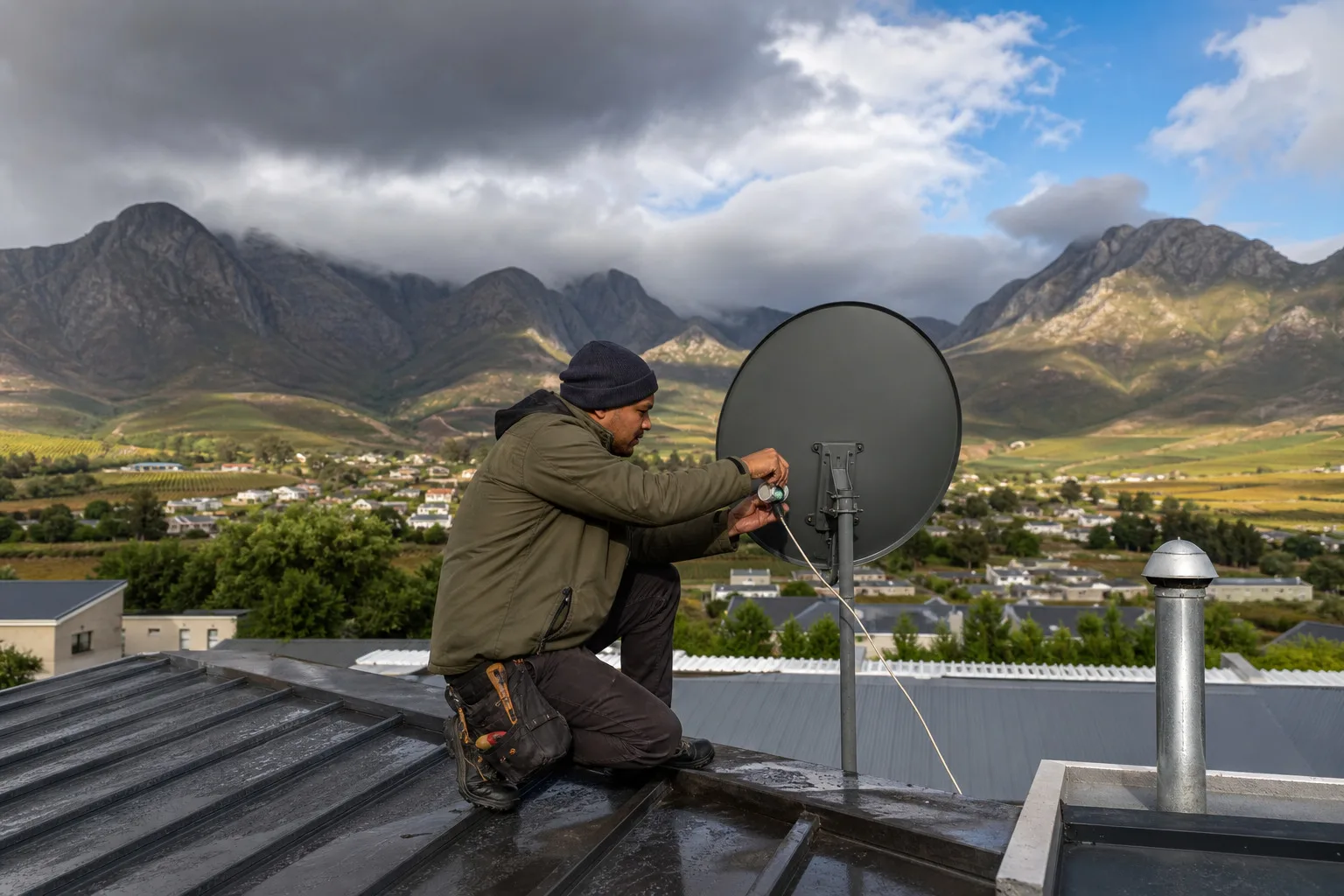
There is a particular kind of frustration that comes with a black screen on a wet evening. A storm rolls in off the Hex River mountains, the wind picks up, the rain hammers down: and right as you settle in, the picture freezes and "No signal" appears. Before you assume the worst, take a breath. Around Worcester, most post-storm signal losses come down to a handful of simple causes, and a few of them you can sort yourself in five minutes.
Check 1: Wait out the worst of the weather
This one feels too obvious, but it is genuinely the most common. Heavy rain and thick cloud physically weaken a satellite signal: it is called rain-fade, and even a perfectly healthy dish can drop out at the peak of a downpour. If the picture vanished exactly as the storm hit its hardest, give it fifteen or twenty minutes. Very often it comes straight back as the cloud thins, and there is nothing wrong at all.
If it stays dead long after the rain has passed, though, the storm has probably done something physical: and that is where the next checks come in.
Check 2: Restart the decoder properly
Decoders are little computers, and like any computer they occasionally need a hard restart: especially after a power flicker, which storms love to cause. Switch the decoder off at the wall, not just the remote, wait a full thirty seconds, and switch it back on. Let it boot all the way up before you judge it. A surprising number of "broken" installs are fixed by exactly this, and it costs you nothing to try.
Check 3: Look at your cables and connections
With the power off, check the cable running into the back of the decoder. Is it finger-tight at the connector, or has it worked loose? Follow it as far as you safely can and look for obvious damage: a chewed section, a cable pulled taut, a connector green with corrosion. Valley heat perishes older coax, and a storm is often just the final straw that exposes a fault that was already there.
- Hand-tighten the F-connector at the decoder and the wall plate.
- Look for cracked or sun-perished cable, especially outdoors.
- Check the plug and any multiplug: storms trip these constantly.
Check 4: Look at the dish (from the ground)
From a safe spot on the ground, glance up at your dish. Has it visibly shifted, drooped or rotated? Is there a branch resting against it, or has something blown onto it? You will not be able to re-aim it yourself: that needs a meter and a head for heights: but if it is obviously knocked, you have found your answer, and you can tell us exactly what is wrong when you call.
When it is time to call a local installer
If you have worked through all four checks and the screen is still blank, the fault is almost certainly one of three things: a dish knocked off alignment, a failing LNB, or weather-damaged cabling. None of these are DIY jobs: they need the right meter, the right spares and someone comfortable working at height. This is bread-and-butter work for our DStv signal repair team, and around Worcester we can usually be out the same week, often the next day for an urgent fault.
The most common culprit by far is alignment. A dish that was only roughly aimed has no margin to spare, so the first big storm of the season tips it over the edge. Getting it back on peak with a proper dish alignment: and sealed against the next round of weather: is what turns an annual signal battle into a system you can forget about. It is also worth understanding why coastal-grade and valley-grade installs differ; if your setup has been struggling for a while, the underlying issue is often that it was never built for our conditions in the first place.
Stopping it happening again
Once you are back up and running, a little prevention goes a long way in the Breede River Valley. A quick service check every couple of seasons catches perished cable and a drifting dish before they leave you in the dark on the worst possible night. We will happily look over an older setup, re-seal what the heat has opened up, and confirm the alignment is still true.
Storm damage is exactly the kind of fault that needs doing right the first time: it is why so many households in the valley choose an experienced DStv installation Worcester homeowners already trust for both repairs and new setups.
If your home is a holiday house or guest farm that sits closed up for stretches, it is doubly worth a pre-season once-over: there is more on that in our guide to getting a guesthouse signal-ready for the season. And whatever the issue, if you would rather just have it sorted properly, we cover Worcester and the wider Breede River Valley. Get in touch and we will get your picture back.